
Florida Stop Sign Accident Claims and Fault Rules
A Florida stop sign accident can appear straightforward at first glance. One driver stopped while the other did not, making it seem easy to assign blame.
The situation often becomes complex once the facts are gathered. Because these are some of the most common types of intersection accidents, factors like a rolling stop, a blind corner, a left turn, or a distracted driver can split fault between both parties.
Florida law does not treat every crash the same way. The specific details regarding speed, right-of-way, and visibility often determine the outcome of the claim, especially when evidence suggests one driver was actually running a stop sign.
Key Takeaways
- Fault is not automatic: A collision at a stop sign does not automatically assign full liability to the driver who was required to stop; investigators evaluate multiple factors like visibility, speed, and driver distraction.
- Florida comparative negligence: Under Florida’s modified comparative negligence system, you must be 50 percent or less at fault to recover damages; if you are 51 percent or more at fault, your claim is entirely barred.
- Evidence impacts recovery: Your final compensation is directly tied to your assigned percentage of fault, making it critical to gather dashcam footage, witness statements, and accident reconstructions to support your case.
- Avoid early statements: Insurance companies may attempt to pin blame on you immediately; providing a recorded statement before the facts are fully established can permanently damage your ability to claim fair compensation.
Why fault at a stop sign is not automatic
Under Florida Statute 316.123, drivers are required to come to a complete stop at a posted sign and yield the right-of-way before entering the intersection. While these traffic laws are designed to keep intersections safe, a collision does not automatically assign full responsibility to one party. A legal analysis of a Florida stop sign accident involves much more than simply identifying who had the stop sign.
A crash scene often involves a sequence of errors rather than a single mistake. Investigators examine whether the sign was clearly visible, if the other driver was speeding, or if environmental factors like poor weather or blocked sightlines hindered the driver. Even in cases involving a failure to stop or a rolling stop, fault may be shared if the other driver was distracted, speeding, or violating their own duty of care. If a driver had already entered the intersection lawfully, the person at the stop sign may only be partially to blame for the incident.
A stop sign violation is strong evidence, but it is not the whole case.
A driver who ignores a signal is often in a precarious position, but it is rarely the end of the legal inquiry. Because Florida law accounts for the actions of both parties, the outcome of an accident claim often turns on specific, technical details. The same intersection can present different hazards depending on your lane, speed, and overall situational awareness, which is why a thorough investigation is essential to determine true liability.
Florida comparative negligence in 2026
Florida utilizes a modified comparative negligence system for most car accident cases, a legal standard that took effect in March 2023 and remains the governing rule in 2026. Under this framework of comparative negligence, you may only recover damages in a personal injury claim if you are 50 percent or less at fault for the accident. If your share of fault reaches 51 percent or higher, your claim for compensation will be barred entirely.
The math significantly influences the value of every case. If your damages total $100,000 and you are found to be 30 percent at fault, your recovery is reduced to $70,000. Because the insurance company adjusters use these calculations to minimize payouts, a finding of higher fault can shrink your potential recovery quickly.
Fault can also be divided among multiple parties. A delivery van, a third vehicle, or another driver who swerved to avoid the initial crash can all affect the final percentage split. Importantly, the adjuster’s initial assessment is not the final word, as gathering further evidence can help adjust these percentages in your favor. Furthermore, you must remain mindful of the statute of limitations, which dictates the strict time frame you have to file a formal claim following a Florida collision.
If the insurer requests a recorded statement before the facts are fully established, legal guidance after a Florida car crash can help you understand the risks. A short statement may sound harmless, yet it can lock in a narrative about your fault before the scene is thoroughly investigated. The core principle remains simple: the less fault you are assigned, the more money you may recover, and the more blame you carry, the smaller the final settlement becomes.
Common stop sign crash patterns and what they mean
Some crash stories repeat because driver habits repeat. One person performs a rolling stop. Two cars reach a four-way stop at the same time. Someone turns left before the lane clears. A rear-end crash happens beside the sign. Each pattern raises different fault questions, and many of these incidents result in a T-bone collision or other dangerous side-impact collisions.
A rolling stop may seem minor, but it can change liability fast, as explained in how failure to stop affects injury liability.
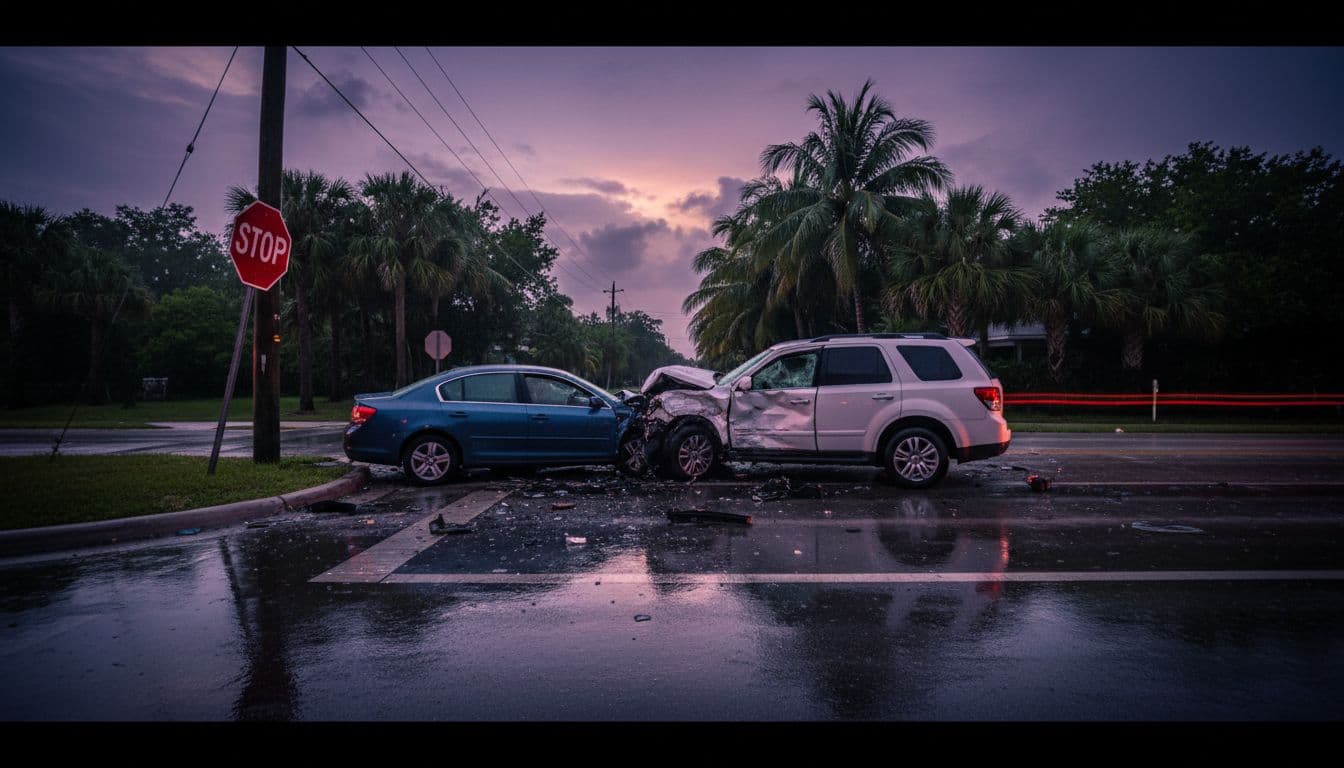
The most common patterns look like this:
| Crash pattern | What matters most | Why fault can shift |
|---|---|---|
| Rolling stop | Whether the driver fully stopped, and whether the other car was visible | A driver at the sign may still share fault if the other car was speeding or hidden |
| Four-way stop | Who arrived first, or who had the car on the right | Both drivers may think they had the right to go first |
| Turning left after stopping | Oncoming speed, distance, and traffic control | The left-turn driver has a duty to yield, but the oncoming driver can also share blame |
| Rear-end collision near a stop sign | Following distance, traffic flow, and sudden braking | The trailing driver is often blamed, but the lead driver may share fault in some situations |
These patterns rarely settle themselves with a guess. A rolling stop often points at the driver who failed to stop, yet the other driver may still bear part of the blame if speed or distraction made the impact worse. At a four-way stop, tiny timing differences can decide who moved first, and failing to properly yield the right of way creates immediate legal complications. A left turn often brings the sharpest dispute because one driver had to wait for the lane to clear. A rear-end crash near a stop sign can also split fault when traffic backed up, visibility was poor, or the lead vehicle stopped in a way that left too little time to react.
In short, a stop sign crash is not a puzzle with one missing piece. It is usually a pile of small pieces that must fit together.
Evidence that can move the fault percentage
Proving fault in a legal dispute turns on the strength of your evidence. Photos taken at the scene can reveal the position of the stop line, skid marks, specific damage points, and the final resting place of each vehicle. Witnesses can confirm who entered the intersection first or who improperly rolled through the sign.

Photo by David Iloba
The most useful evidence often includes:
- Dashcam footage or nearby security camera recordings.
- The official police report and officer notes.
- Witness statements and contact information.
- Cellphone records if distracted driving is suspected as a factor.
- Weather, lighting, and road condition reports.
- Repair photos and detailed medical records.
Each piece of documentation can pull the fault picture in a different direction. While a police report is helpful, it does not act as the final word. An officer may hear one version of events at the scene, while a camera angle might reveal a completely different reality. In complex disputes, it may even be necessary to hire accident reconstruction experts to analyze the physics of the crash.
Road conditions can also matter a great deal. A wet street can lengthen stopping distances, while a dark intersection might obscure a stop sign. A large truck, overgrown hedge, or broken streetlight can also obstruct a driver’s view. In a Florida stop sign accident claim, those environmental details can move fault percentages by a meaningful amount.
Speed also plays a significant role. A driver who enters the intersection at an excessive speed may not be able to stop in time, even if the other driver failed to yield. This is where comparative negligence laws come into play. The claim becomes a complex question of percentages rather than a simple yes or no answer regarding liability.
What a Florida stop sign claim can pay for
A stop sign crash claim involves much more than the repair costs for bent metal. When you are injured, the goal of your personal injury claim is to recover compensation for the various hardships caused by the collision. Medical bills are often the most immediate concern, but your recovery may also include coverage for lost wages, physical therapy, reduced earning ability, and pain and suffering.
In Florida, your own PIP coverage is often the first source of benefits available to pay for your medical bills and a portion of your lost income immediately after an accident. However, if your injuries are severe, you may need to pursue additional damages from the other driver. It is important to remember that while a police officer issuing a moving violation ticket to the other driver serves as helpful evidence, it does not automatically resolve civil liability or guarantee a specific settlement amount.
Your final recovery is also tied to your fault percentage. Under Florida law, a driver who is 20% at fault will recover less than a driver who is 5% at fault. Because these percentages directly impact the value of your case, the facts at the scene matter significantly before any settlement is accepted.
Insurance companies often move quickly when the story seems simple. They may blame the driver at the stop sign and offer a low settlement before the full evidence is gathered. When that happens, the first version of the crash provided by the insurer may not represent the whole truth, and it is vital to ensure your claim reflects the full scope of your damages.
Frequently Asked Questions
If I was partially at fault for a stop sign accident, can I still recover money?
Yes, as long as your share of fault is determined to be 50 percent or less. Under Florida’s modified comparative negligence rules, your total damages will be reduced by your percentage of fault, but you are still entitled to seek compensation for the remainder.
Why shouldn’t I give a recorded statement to the other driver’s insurance company immediately?
Insurance adjusters often seek recorded statements early to lock you into a narrative that may favor their policyholder. These statements can be used to inflate your fault percentage or minimize your injuries before you have had a chance to fully investigate the accident or consult with legal counsel.
Does receiving a traffic ticket at the scene mean I am 100% liable for the crash?
No, a traffic citation is evidence, but it is not a final determination of civil liability. Insurance companies and the court will perform their own analysis of the crash, and it is possible to contest the circumstances even if a ticket was issued to one of the drivers involved.
Conclusion
While a Florida stop sign accident may appear straightforward from the sidewalk, these cases often become highly complex once you dive into the details of a claim file. Florida fault rules require a careful evaluation of who actually came to a full stop, who yielded the right of way, and who made the safer choice given the visibility at the intersection.
Beyond the immediate financial costs, it is important to remember that such incidents can lead to traffic citations and unwanted points on your license. Because small details frequently dictate the final percentage of liability, every Florida stop sign accident claim must be built on concrete evidence rather than assumptions.
Proving fault is essential to protecting your legal rights and ensuring you are not unfairly penalized for another driver’s actions. If the situation remains unclear, seeking case-specific legal help can provide the clarity you need before an insurance company establishes a narrative that works against you.